PhD opportunity [October 2026 start] on "Intelligent deep learning neuroimaging system for guiding brain tumour treatment"
Applications are invited for a fully funded 1+3 years MRes+PhD or 4 years PhD EPSRC CDT PSI studentship (including tuition fees, annual stipend and consumables) starting in October 2026.
Award details:
- Focus: Intelligent deep learning neuroimaging system for guiding brain tumour treatment
- First supervisor: Jonathan Shapey
- Second supervisor: Tom Vercauteren
- Funding type: 4-year fully-funded EPSRC CDT PSI studentship including a stipend, tuition fees, research training and support grant (RTSG), and a travel and conference allowance.
- Start date: October 2026
Project description
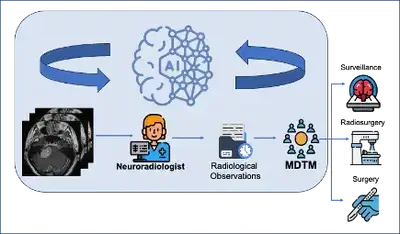
Vestibular Schwannoma (VS) is a non-cancerous brain tumour that grows from the inner ear, towards the brain. At current rates, approximately 1 in 1000 people will be diagnosed with a VS in their lifetime. Patients with VS require individualized patient management that may include imaging surveillance, radiation treatment or surgery.
This project aims to: 1) optimise deep learning models to automatically detect and segment VS using MRI; 2) integrate the framework into a tool capable of being deployed in the clinic; and 3) conduct a prospective clinical pilot study to evaluate the clinical impact of using AI-based tool in patient management.
Modern learning-based image-registration methods will be utilised to provide robustness and computational efficiency. The clinical pilot study will provide the foundation for a future multicentre interventional study aimed at assessing clinical effectiveness and health economic impact.
Application Process

Jonathan Shapey
Clinical Academic and Consultant Neurosurgeon
Jonathan’s academic interest focuses on the application of medical technology and artificial intelligence to neurosurgery.
Tom Vercauteren
Professor of Interventional Image Computing
Tom’s research interests include machine learning and computer assisted interventions